
How to Implement a Security Plan for New Dallas Business Owners
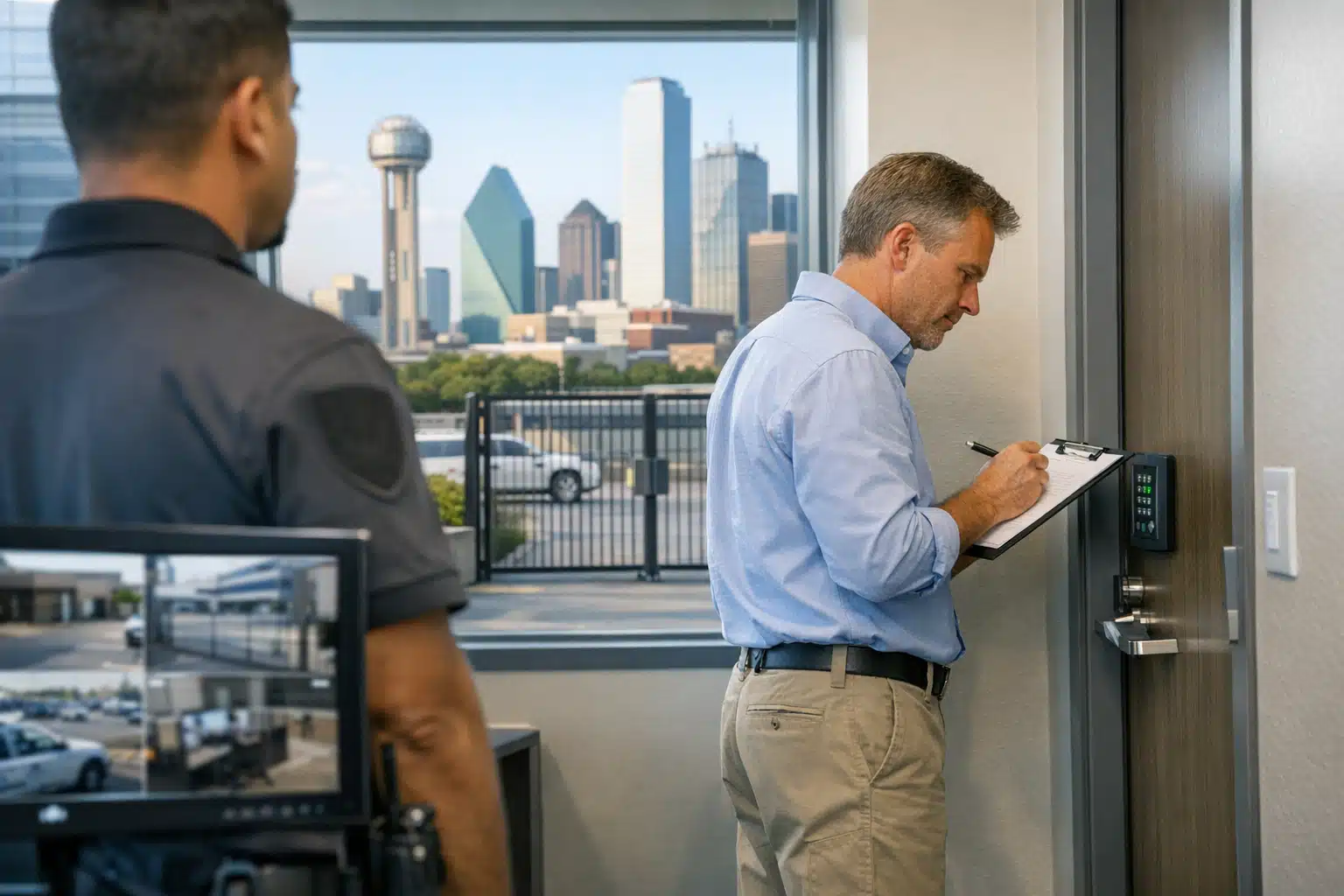
To implement a security plan for your new Dallas business, start with a thorough risk assessment of your location and assets. Document potential threats to people, inventory, and equipment. Then evaluate protection options such as on-site security guards or remote video monitoring systems. Create a written plan that addresses identified risks before problems occur, and review it regularly as your business grows.
Dallas reported over 60,000 property crimes in a recent year, according to city police data. For a first-time owner opening a storefront, warehouse, or office, that number carries real weight. A written security plan gives you a way to protect people, inventory, and equipment before problems start. This post walks new business owners in Dallas step by step from risk assessment to picking between on-site guards and remote video monitoring.
Why a Security Plan Matters for New Business Owners in Dallas
A security plan is a written document that maps your risks, your protections, and your response steps. It answers three questions: what could go wrong, how you prevent it, and who acts when an alarm triggers.
New business owners face higher exposure in their first year. Criminals watch for signs of a fresh operation with untested routines and unlocked back doors.
Dallas neighborhoods carry different risk profiles. A restaurant in Deep Ellum deals with late-night foot traffic. A distribution center off I-35 near Farmers Branch faces cargo and copper theft.
Your plan should match the block you sit on, not a generic template.
What a Real Security Plan Includes
- Asset inventory — cash drawers, electronics, tools, vehicles, and stored goods
- Threat list — break-ins, vandalism, internal theft, trespassing, after-hours loitering
- Physical controls — locks, lighting, fencing, cameras, access points
- Human controls — guards, patrols, or remote monitoring operators
- Response protocol — who calls Dallas PD, who reviews footage, escalation order
Step 1: Assess Your Site With a Physical Walk-Through
Start by walking your property at three times: morning open, mid-day, and after dark. Lighting and blind spots change completely between 2 p.m. and 10 p.m.
Note every door, window, and gate. Mark which ones face the street and which sit hidden from view.
A dumpster corral behind a strip mall is a common entry point in Dallas retail burglaries. Roof hatches on older warehouses near the Design District are another weak spot.
Questions to Answer During the Walk-Through
- Where can someone hide from street view after dark?
- Which entry points lack cameras or motion lighting?
- How far is the nearest Dallas PD patrol division?
- Who has keys or access codes, and how many copies exist?
- What single item would hurt most if it disappeared overnight?
Write the answers down. That page becomes the foundation of your written plan.
Step 2: Compare On-Site Guards and Remote Video Monitoring
Two main methods protect a Dallas business: on-site security guards and remote video surveillance. Each fits different budgets and site types.
On-Site Security Guards
An on-site guard gives a visible presence that deters crime and handles people in real time. This fits event venues, apartment lobbies, and construction sites during active work hours.
Guards can check IDs, walk patrols, and respond to disputes. The trade-off is cost, since one post staffed around the clock needs multiple officers on rotation.
Remote Video Surveillance
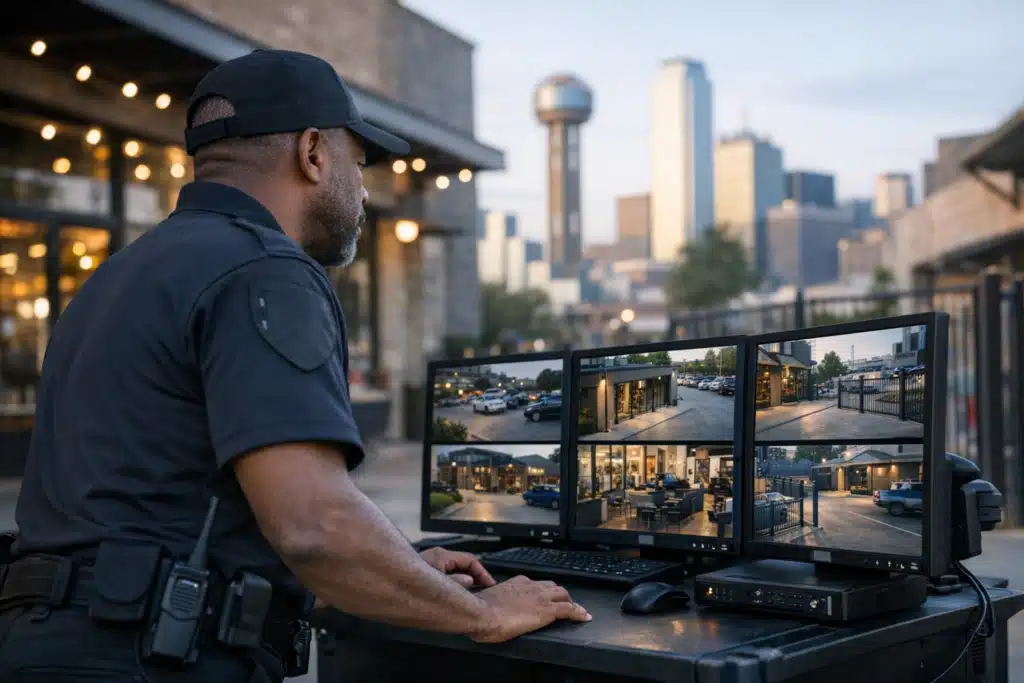
Remote video surveillance uses live cameras watched by trained operators off-site. Analytics flag movement, and operators can trigger voice-down warnings over on-site speakers.
This method covers large or fenced areas at lower cost than full guard coverage. It suits construction lots, storage yards, and car dealerships along the Dallas corridors.
A voice-down warning stops many intruders before they touch anything. Hearing a live operator call out their clothing color sends most trespassers running.
Which One Fits a New Business
- High foot traffic and public interaction — on-site guards
- Large open sites or after-hours coverage — remote monitoring
- Tight startup budget with wide area — remote monitoring
- Mixed needs — daytime guard plus overnight video
Many Dallas owners pair both. A guard covers business hours, and remote cameras watch the empty lot at night.
Step 3: Prevent Construction and Equipment Theft
Construction theft costs contractors and developers heavily across North Texas. Copper wire, catalytic converters, tools, and lumber vanish from unsecured sites overnight.
Dallas building activity stays high, which keeps job sites in the target zone. A partly built structure with no doors is an open invitation after crews leave.
How Remote Surveillance Protects a Dallas Job Site
Mobile camera towers set up in hours and need no permanent power. Operators watch the perimeter live from dusk to dawn.
When motion crosses a set line, the operator sees it, speaks a warning, and calls police if the person stays. Recorded footage supports any theft report and insurance claim.
This costs far less than posting two overnight guards on an open lot. For a new developer, that saving matters during a first project.
Step 4: Write Down Your Response Protocol
A plan fails if nobody knows what to do when an alarm sounds. Assign roles before an incident, not during one.
Build a Simple Escalation Chain
- Detection — camera or guard spots the threat
- Warning — voice-down or on-site verbal command
- Police contact — operator or manager calls Dallas PD with a location and description
- Owner notification — a text or call to you with the footage
- Review — next morning, log what happened and adjust
Keep this chain on one page near the register or in your phone. Every manager should know it cold.

 Posted on Google
Step 5: Review and Update Your Plan Quarterly
A security plan is not a one-time document. Your risks shift as you add inventory, hire staff, or extend hours.
Set a calendar reminder every three months. Walk the site again and check whether cameras still cover the right angles.
Seasons change Dallas risk too. Longer summer evenings mean more late foot traffic, and holiday retail brings higher cash on hand.
Quarterly Review Checklist
- Test every camera feed and confirm night visibility
- Collect keys or codes from anyone who left the company
- Trim bushes or fix lights that block camera views
- Confirm your monitoring contact numbers are current
- Review any incidents from the past quarter
Common Mistakes New Dallas Owners Make
First-time owners tend to buy cameras that record but nobody watches. Footage after a break-in helps police but does not stop the loss.
Live monitoring or an on-site guard prevents the crime instead of documenting it. That difference decides whether you lose inventory at all.
Another mistake is skipping the written plan entirely. Insurance carriers and landlords increasingly ask for one before signing.
A documented plan can lower premiums and satisfy lease requirements in many Dallas commercial buildings.
Get a Dallas Security Assessment
A strong security plan starts with an honest look at your site, your risks, and your budget. New business owners in Dallas gain the most by acting before the first incident, not after.
Twin City Security Dallas builds site-specific plans using on-site guards, remote video monitoring, or both. Call or text 972‑385‑1144, email Dallas@twincitysecurity.com, or visit https://www.twincitysecuritydallas.com for a Dallas security assessment or monitoring quote.
Sources
- Dallas Police Department – Crime Statistics and Reports
- FBI – Uniform Crime Reporting (UCR) Program
- National Insurance Crime Bureau – Theft and Fraud Data
This guide helps new Dallas business owners create a security plan to protect against property crime, covering risk assessment, choosing between on-site guards and remote video monitoring, and building response protocols.
- Dallas reported over 60,000 property crimes recently, making written security plans valuable for new businesses. The plan should match your specific location and include asset inventory, threat lists, physical controls, and response steps.
- On-site guards work best for high foot traffic and public interaction, while remote video surveillance suits large open sites and after-hours coverage at lower cost. Many owners combine both methods.
- Walk your property at different times of day to identify blind spots and weak entry points. Review and update your plan quarterly as inventory, staff, and hours change.