
Comparing Security Options for Dallas High-Rise Buildings
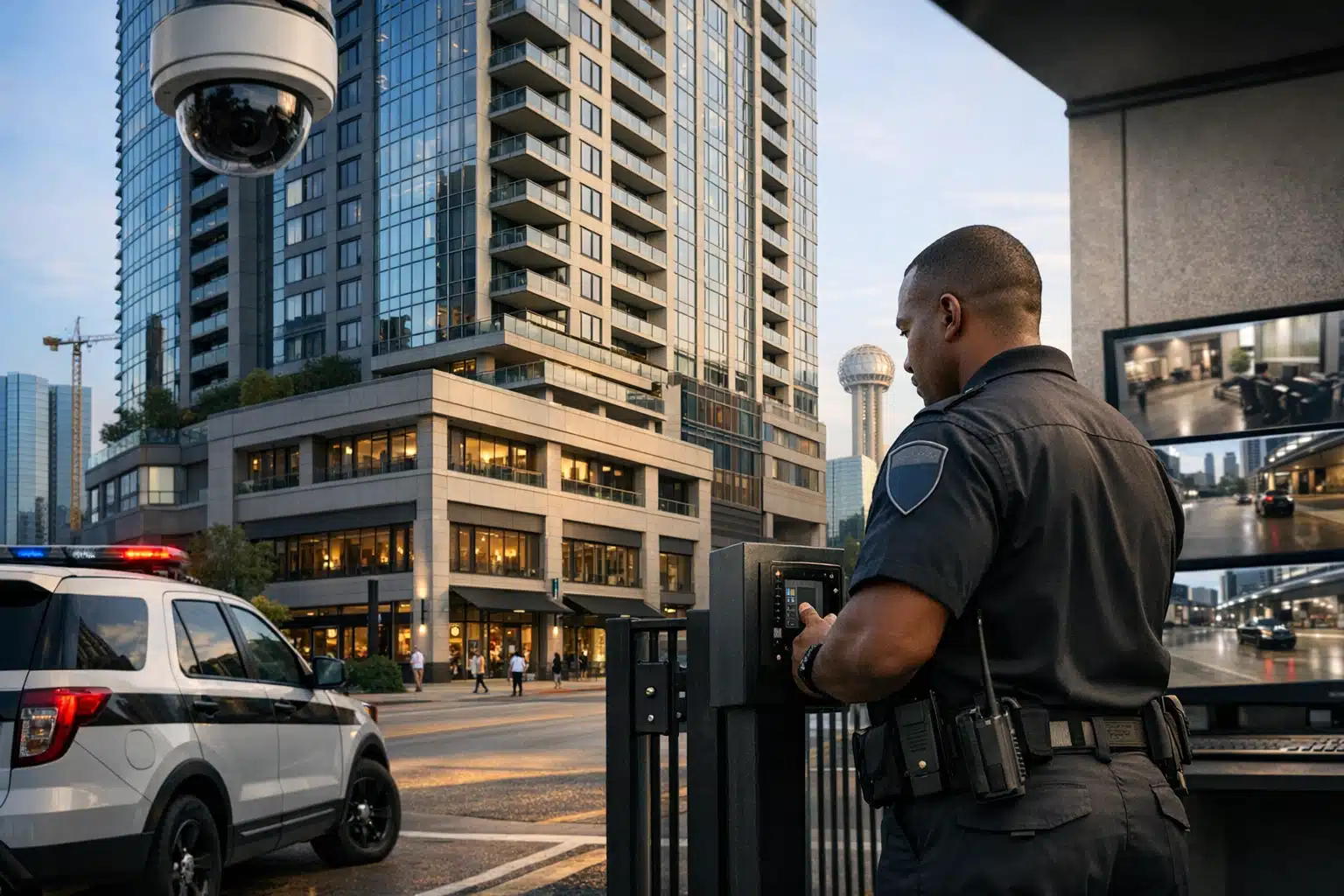
Dallas high-rise buildings face unique security challenges due to their vertical design. A typical 30-floor tower has one main lobby but dozens of entry points, multiple elevators, parking levels, and amenity decks that all require monitoring. This complexity makes high-rise security significantly more difficult than ground-level coverage, requiring property managers to implement layered security solutions that address each access point effectively.
Dallas added more high-rise towers downtown and in Uptown over the past decade than any other Texas market outside Houston. That vertical growth brings a problem many property managers underestimate: high-rise security is harder than ground-level coverage. A 30-floor tower has one lobby but dozens of entry points, elevators, parking levels, and amenity decks. This post compares the building security options available to Dallas high-rise managers and shows where each one fits.
You will learn how on-site guards, remote video surveillance, and access control stack up on cost, coverage, and response speed. The goal is a clear answer to a common question: what protects a Dallas tower best?
Why High-Rise Security Differs From Standard Commercial Buildings
A high-rise is not one building. It is many small zones stacked on top of each other. Each zone carries its own risk.
Consider a typical Dallas tower on McKinney Avenue. It holds ground-floor retail, a parking podium, residential or office floors, and a rooftop amenity level. One guard at the front desk cannot see any of that.
The vulnerabilities that define high-rise risk in Dallas:
- Parking garages account for a large share of vehicle break-ins reported downtown.
- Tailgating at lobby doors lets unauthorized people ride elevators up.
- Loading docks and freight elevators stay propped open during deliveries.
- Stairwells become blind spots when fire codes require they stay unlocked from inside.
- Amenity decks and rooftops draw after-hours trespassers and liability claims.
Dallas fire code also limits how you lock stairwell doors. That rule protects occupants but creates security gaps. Any plan for a tower must respect that constraint.
On-Site Security Guards for Dallas High-Rise Buildings
On-site guards place trained personnel inside the building. They staff the lobby, patrol floors, and respond to incidents in person.
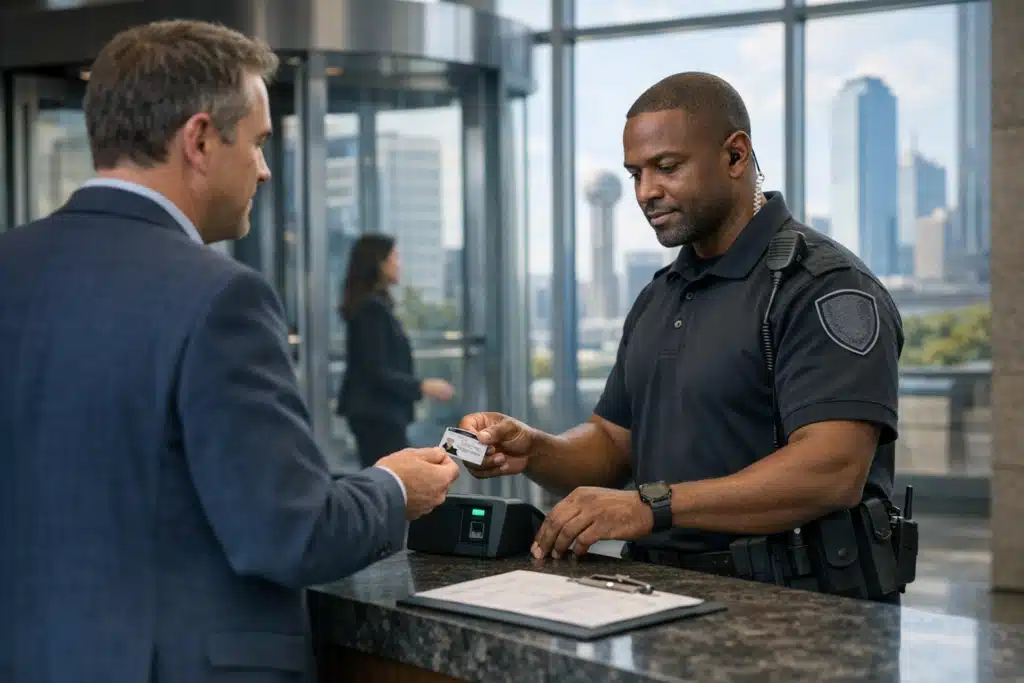
What on-site guards do best
A lobby guard controls the first point of entry. They greet visitors, verify access, and stop tailgating before it reaches the elevators.
Foot patrols cover what cameras miss. A guard walking the parking podium at 2 a.m. deters break-ins that a fixed camera only records after the fact.
On-site guards hold clear advantages:
- Immediate physical response to medical calls, disputes, or trespassers.
- Visible deterrence that discourages opportunistic crime.
- Face-to-face service for tenants and visitors.
- Ability to enforce building rules in real time.
The cost reality of 24/7 guard coverage
Round-the-clock staffing of one post requires roughly 4.2 full-time guards to cover all shifts, weekends, and relief. For a Dallas tower, a single 24/7 lobby post runs a meaningful monthly line item.
Covering multiple posts multiplies that cost. A building wanting lobby, garage, and patrol coverage quickly reaches a six-figure annual budget. That price buys real protection, but many mid-size towers cannot justify it for every zone.
Remote Video Surveillance for High-Rise Coverage
Remote video surveillance is live monitoring of your cameras by trained operators at an off-site center. When a camera detects motion in a restricted area, an operator reviews the feed and acts.
This model fits high-rises because towers have many zones and few staff. One operator can watch dozens of cameras across every floor at once.
How remote monitoring handles Dallas tower blind spots
Operators watch garages, loading docks, stairwells, and rooftops in real time. Analytics flag a person entering a zone after hours. The operator then verifies the threat and responds within seconds.
A trained operator can:
- Confirm an alert is a real intruder, not a shadow or animal.
- Trigger a live voice-down speaker to warn the person off.
- Dispatch Dallas police with a verified, in-progress report.
- Notify on-site staff and the property manager at once.
- Save the recorded clip for evidence and insurance.
Verified alarms matter in Dallas. Police prioritize calls confirmed by a live witness over unverified sensor trips. That verification shortens response time when it counts.
Cost compared to on-site guards
Remote monitoring covers many zones for a fraction of 24/7 guard cost. One monitoring contract can watch the garage, dock, roof, and stairwells that would otherwise need three or four guards.
The trade-off: remote operators cannot physically restrain someone or hand a key to a locked-out tenant. They see and respond, but boots on the ground still matter for certain posts.
Access Control and Video Intercom Systems
Access control decides who enters and when. In a high-rise, it governs the lobby, elevators, garage gates, and amenity floors.
Elevator access control is the sharpest tool a tower has. Key fobs or mobile credentials restrict each rider to authorized floors. A visitor cannot ride to a residential level without a resident granting access.
Access control strengthens a high-rise by:
- Logging every entry with a time stamp and credential.
- Restricting elevator floors by tenant or role.
- Locking amenity decks to residents during set hours.
- Cutting a lost credential instantly without re-keying.
Access control works best paired with monitoring. The system logs the door event, and the camera shows who walked through it. Together they answer both “who” and “what happened.”

 Posted on Google
Comparing Your Building Security Options Side by Side
No single method covers a Dallas tower completely. Each building security option fills a different gap. The table below frames the trade-offs.
On-site guards
Best for: lobby control, physical response, tenant service. Weakness: high cost per post, limited to where the guard stands.
Remote video surveillance
Best for: garages, docks, roofs, stairwells, after-hours coverage. Weakness: no physical intervention.
Access control
Best for: entry decisions, elevator restriction, audit logs. Weakness: passive without cameras or staff to back it up.
Building a Layered Plan for a Dallas Tower
The strongest high-rise security plans combine methods by zone. Match each tool to the risk it handles best.
A practical layout for a 25-floor Dallas tower:
- Lobby: one on-site guard controlling the main entry during business and peak hours.
- Elevators: access control restricting floors by credential.
- Garage and loading dock: remote video monitoring with voice-down speakers.
- Stairwells and rooftop: analytics cameras watched by off-site operators.
- Overnight hours: remote monitoring replaces several guard posts at lower cost.
This layout puts a human where human judgment matters most. It covers every other zone with technology that never takes a break. The result protects more of the building for less than full guard staffing.
Questions to ask before choosing
Before you sign any contract, answer these about your Dallas property:
- Which zones have had incidents in the past year?
- When do most problems happen, day or overnight?
- Do tenants need face-to-face lobby service?
- What does your insurer require for premium discounts?
- How fast can Dallas police reach your address?
Your answers point to the right mix. A residential tower with heavy evening traffic needs different coverage than a nine-to-five office building.
Conclusion
Dallas high-rise buildings carry layered risks that no single method solves alone. On-site guards handle lobby control and physical response, remote video surveillance covers garages and blind spots at lower cost, and access control governs who moves where. The smartest plans assign each tool to the zone it protects best.
Twin City Security Dallas assesses your tower and builds coverage that matches its real risks. Call or text 972‑385‑1144, email Dallas@twincitysecurity.com, or visit https://www.twincitysecuritydallas.com for a Dallas high-rise security assessment.
Sources
- Dallas Police Department – Crime Statistics and Reporting
- City of Dallas – Building Inspection and Fire Code
- U.S. Bureau of Labor Statistics – Security Guards Occupational Outlook
Dallas high-rise buildings face unique security challenges due to multiple entry points, parking levels, and amenity areas that a single guard cannot monitor. The best approach combines on-site guards, remote video surveillance, and access control systems matched to each zone's specific risks.
- On-site guards provide immediate physical response and lobby control but cost significantly more when covering multiple posts around the clock.
- Remote video surveillance allows trained operators to monitor garages, stairwells, and rooftops in real time at a fraction of guard staffing costs - though they cannot physically intervene.
- Access control systems restrict elevator and amenity access by credential while logging every entry, but work best when paired with cameras or staff for backup.