
How to Prevent Unauthorized Access in Dallas Commercial Properties
Preventing unauthorized access in Dallas commercial properties requires addressing common security gaps like unlocked doors, shared key codes, and unmonitored entrances. Business owners should implement strong access control systems, eliminate shared credentials, secure all entry points including side doors, and install monitoring solutions designed for urban environments to protect against the city's high rate of commercial burglaries.
Dallas reported over 60,000 property crimes in a recent year, and commercial burglaries hit warehouses, offices, and retail spaces hardest. Most of those break-ins share one weakness: poor access control. Doors left unlocked, shared key codes, and unmonitored side entrances give intruders easy paths inside. This post shows Dallas business owners and property managers how to close those gaps with practical steps built for the city’s urban conditions.
What Access Control Means for Dallas Commercial Properties
Access control is the set of physical and digital measures that decide who enters your property, when, and where. It covers locks, credentials, cameras, and staff who verify identity at entry points.
In Dallas, the stakes run high across property types. A Deep Ellum event venue faces different threats than a Trinity Groves restaurant or an Oak Cliff apartment community.
Strong access control does three things:
- Blocks unauthorized entry at every door and gate
- Creates a record of who came and went
- Slows intruders long enough for a response
Weak access control fails at all three. That failure is why so many local burglaries succeed after hours.
Why Dallas Properties Face Higher Access Risks
Dallas spreads across more than 380 square miles with heavy commercial density near I-35E, US-75, and the LBJ corridor. That layout gives intruders quick highway escape routes after a break-in.
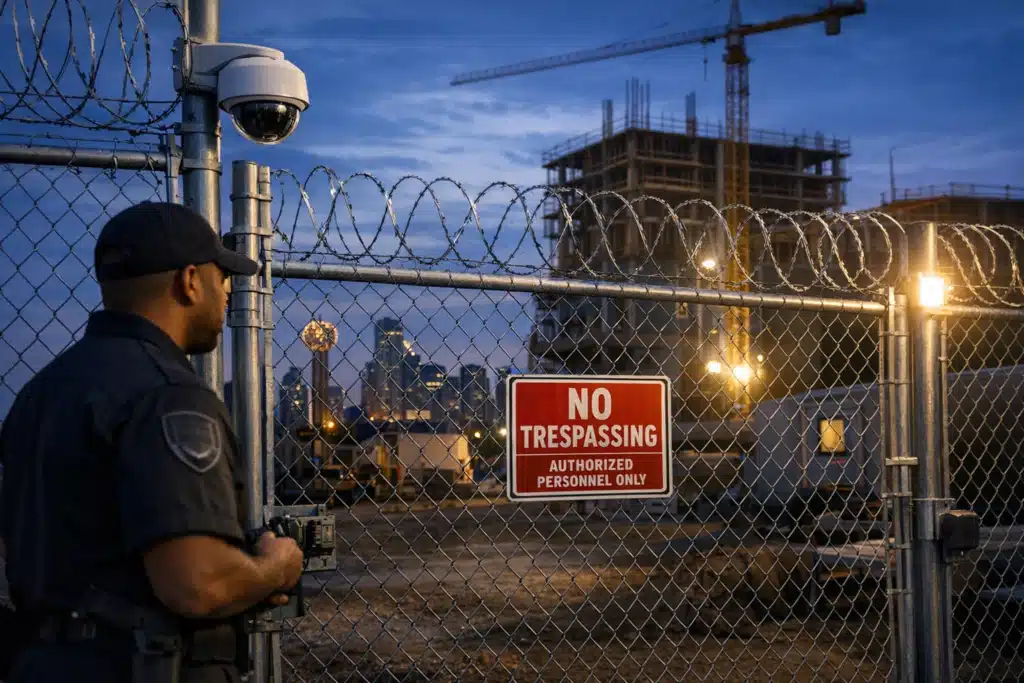
Construction sites face the sharpest exposure. The Dallas-Fort Worth metro leads the nation in construction starts, and copper, tools, and heavy equipment vanish from unsecured lots weekly.
Apartment communities near downtown deal with tailgating, where an outsider follows a resident through a gate. Retail centers along Preston Road struggle with after-hours entry through poorly lit rear doors.
Each of these problems traces back to one thing: entry points that nobody verifies or watches.
How to Build Layered Access Control in Dallas
To secure a Dallas commercial property effectively, follow these steps in order. Each layer supports the next.
Step 1: Map Every Entry Point
Walk your property and list all doors, gates, loading docks, and windows at ground level. Include roof hatches and utility access panels.
Most Dallas break-ins happen at overlooked entrances. A single propped-open fire exit behind a strip mall gives thieves a clean way in.
Mark which entries staff use daily and which stay locked. This map becomes the foundation for everything that follows.
Step 2: Replace Shared Keys With Credential Systems
Physical keys are the weakest link in commercial security. A former employee with a copied key can return months later.
Swap keys for one of these credential types:
- Key fobs or cards — easy to deactivate when staff leave
- Mobile credentials — phone-based entry with instant revocation
- PIN codes — assign a unique code per person, never one shared code
- Biometric readers — fingerprint or facial entry for high-value areas
For a Dallas warehouse storing equipment, fobs plus a logged entry system stop old employees from returning after termination.
Step 3: Add Verified Human Oversight
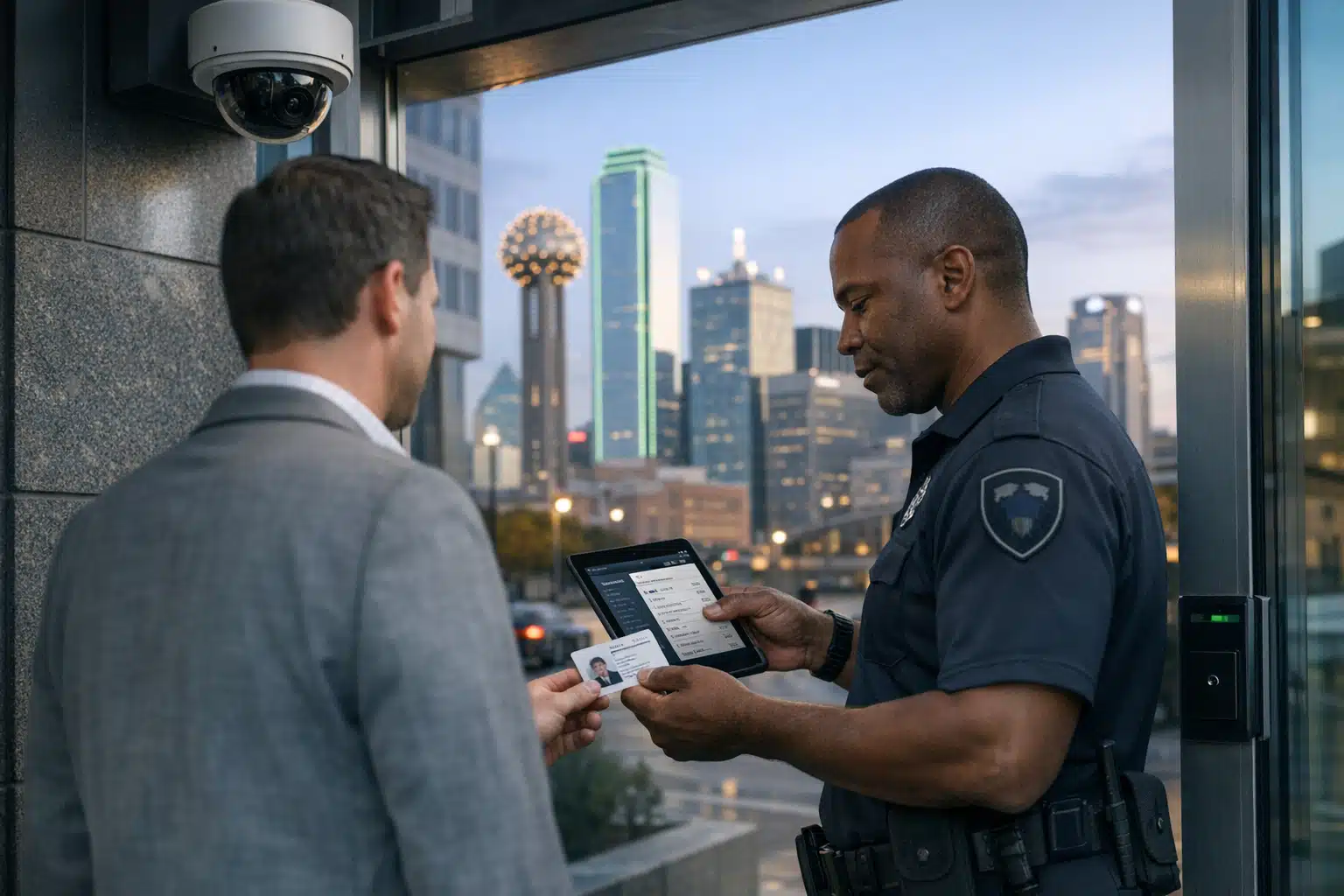
Technology alone misses what a trained person catches. An on-site guard checks IDs, spots tailgaters, and responds when an alarm triggers.
At a Dallas apartment gate, a guard prevents the tailgating problem that automated gates cannot. The guard confirms each vehicle before it passes.
For lower-traffic sites, remote video surveillance covers the same ground at lower cost. A monitoring agent watches live feeds and speaks through on-site speakers when someone enters after hours.
Step 4: Light and Monitor Every Blind Spot
Dark corners invite intrusion. Add motion-activated lighting at rear doors, loading bays, and parking structures.
Pair lighting with cameras positioned to read faces and license plates. In Dallas, plate capture helps police track vehicles fleeing onto nearby highways.
Position at least one camera to record every entry point on your map from Step 1.
Step 5: Log and Review Entry Data
Credential systems record every entry with a timestamp and identity. Review that log weekly.
Patterns reveal problems early. Repeated after-hours access by one badge, or entries at a door that should stay locked, signal trouble before a loss occurs.
On-Site Guards vs. Remote Surveillance for Dallas Businesses
Choosing between guards and remote monitoring depends on your property, traffic, and budget. Here is how they compare for local sites.
When On-Site Guards Make Sense
On-site guards fit properties with steady foot traffic or high-value assets. A downtown Dallas event venue with hundreds of guests needs guards at entrances to check credentials and manage crowds.
Guards work best when you need:
- Physical presence that deters and responds instantly
- ID verification at busy entry points
- Crowd or visitor management
- Immediate hands-on response to incidents
When Remote Surveillance Fits Better
Remote surveillance covers large or low-traffic sites at a fraction of on-site guard cost. A Dallas construction lot sitting empty overnight gains protection without a guard walking the perimeter for eight hours.
Remote monitoring is a system where trained agents watch live camera feeds off-site and act when they detect intrusion. Agents issue voice warnings, alert police, and dispatch responders.
Remote surveillance works best when you need:
- Overnight coverage of empty sites
- Wide-area monitoring across a large lot
- Lower cost per hour of protection
- Fast police notification with recorded evidence
Combining Both for Full Coverage
Many Dallas properties use both. Guards cover business hours, and remote surveillance takes over after close.
A retail center on Preston Road might staff a guard during shopping hours, then shift to camera monitoring overnight. This keeps costs down without leaving gaps.
Local Response Time Advantages in Dallas
Response speed decides whether an intrusion becomes a loss. Dallas police cover a wide area, and response times to burglary alarms vary by district.
A monitoring agent who verifies an intrusion on camera gives police an active-crime report, not just an alarm. Verified reports move up the priority queue.
On-site guards close the gap further. A guard responds in seconds, not minutes, and holds the scene until police arrive.
For a construction site off I-35E, that speed difference can save thousands in copper and equipment.

 Posted on Google
Common Access Control Mistakes Dallas Properties Make
Avoid these errors that undo even good security setups:
- Sharing one gate code — one leaked code opens the property to everyone
- Skipping camera maintenance — a dead camera records nothing
- Ignoring back entrances — thieves target the doors you forget
- Never deactivating old credentials — former staff keep access for months
- Poor lighting at loading docks — dark bays invite after-hours theft
Fixing these costs little compared to the loss of a single break-in.
How Twin City Security Dallas Approaches Access Control
Twin City Security Dallas assesses each property against its actual risk, not a template. A construction lot, an apartment gate, and an event venue each get a plan matched to their entry points and traffic.
Our teams combine trained on-site officers with remote video monitoring. That mix gives Dallas businesses coverage that fits both their layout and budget.
We know the local streets, the highway escape routes, and how Dallas police prioritize verified alarms. That knowledge shapes where we place cameras and post guards.
Conclusion
Preventing unauthorized access in Dallas comes down to layered defense: mapped entry points, credential systems, human oversight, lighting, and reviewed entry logs. Match on-site guards to busy or high-value sites and remote surveillance to large or overnight ones. For a Dallas security assessment or a monitoring quote built for your property, call or text Twin City Security Dallas at 972‑385‑1144, email Dallas@twincitysecurity.com, or visit https://www.twincitysecuritydallas.com.
Sources
- Dallas Police Department – Crime Statistics and Reporting
- FBI – Uniform Crime Reporting Program
- Cybersecurity and Infrastructure Security Agency – Physical Security
Dallas commercial properties face high break-in risks due to poor access control, with over 60,000 property crimes reported in a recent year. This guide from Twin City Security Dallas explains how to build layered defense systems to prevent unauthorized entry.
- Most Dallas burglaries exploit weak points like unlocked doors, shared key codes, and unmonitored entrances. The city's highway layout gives intruders quick escape routes after break-ins.
- Effective access control requires mapping all entry points, replacing shared keys with credential systems, adding human oversight through guards or remote monitoring, and installing proper lighting with cameras.
- On-site guards work best for high-traffic or high-value sites, while remote video surveillance suits large or overnight properties. Many Dallas businesses combine both for full coverage.